Tornapiel
Cooke Latham Gallery (2025)
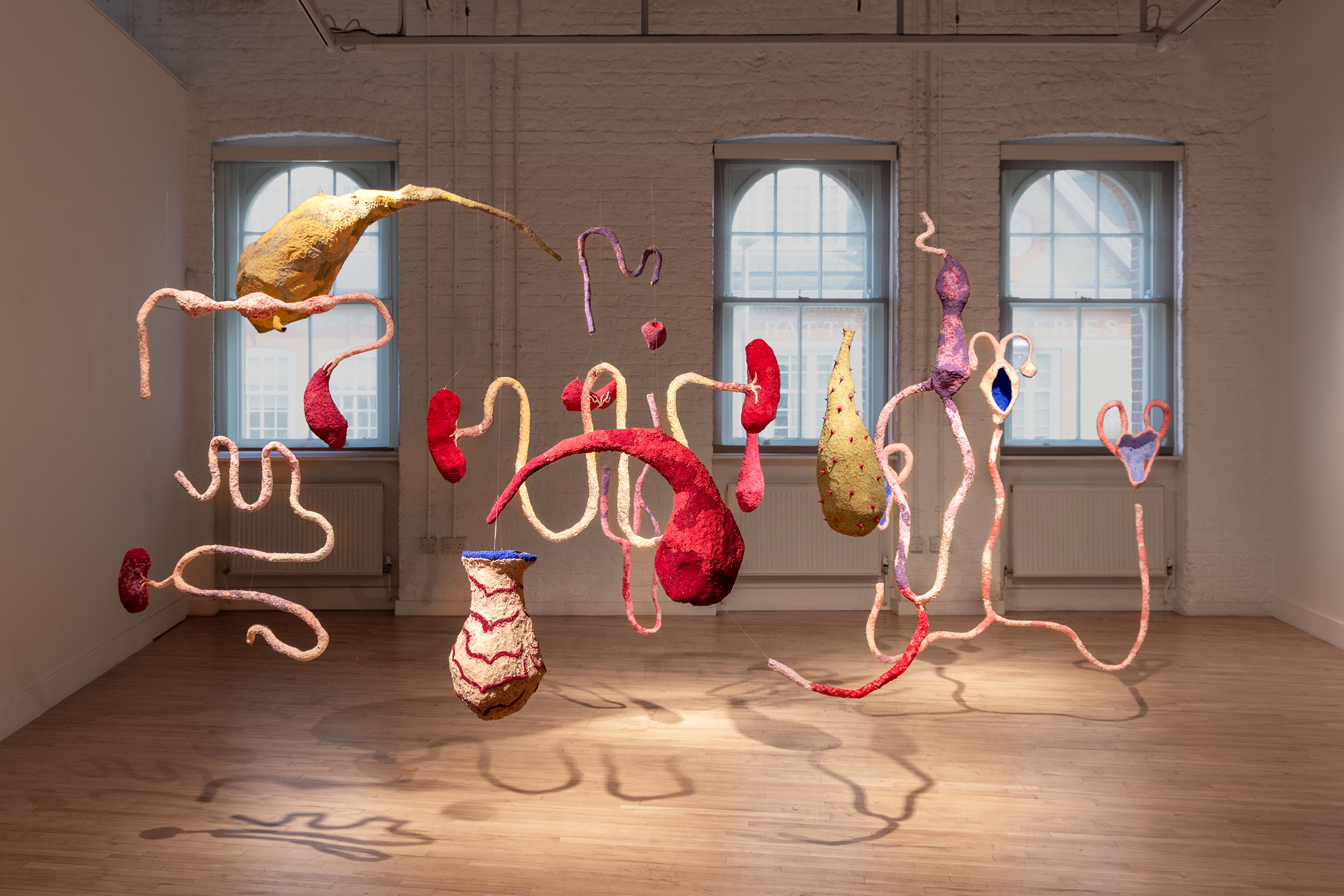
Internal landscape (2025)
Dyed paper pulp, wire and metal mesh
Dyed paper pulp, wire and metal mesh
[EN]
At the heart of Blanca Gracia’s exhibition lies the concept of body horror, the societal revulsion towards a bodily ‘other’ that fails to conform to a heteronormative standard. With its roots in Greek myth and its more recent tendrils woven throughout the contemporary horror genre, Gracia challenges these bodily fictions to create a new and celebratory manifestation of a body in revolt. A giant constellation of sculptural organs float, seemingly untethered, in the gallery space. Their scale conjures the idea of a forest through which the visitor can walk; an arboreal encounter with a ‘monstrous’ internal female landscape.
The accompanying audio work merges sounds of the forest and the body, wind and heartbeat, again aligning the idea of the body as a potential wilderness, the site of outcasts, of beasts, of mythical beings. It harnesses a feeling of vulnerability towards a world less dominated by societal constructs and teases the listener with the known audio cues for ‘horror’. There is a fairytale tinkling invitation to explore, an implicit ‘if you go down to the woods today…’
The title of the exhibition, Tornapiel, was invented by the artist and is derived from the Latin word versipellis, which translates literally to “skin turning”. This term was originally used to define creatures that looked like us but could change their appearance at will, the Roman precursor to witches and werewolves. In the context of the exhibition Gracia literally turns the body inside out, the inference being that it is not the creatures themselves that horrify us but rather the human ability to manifest these forms. The idea of a ‘deviant’ entity latent within us all.
Lining the walls of the gallery, Gracia’s watercolours are resonant of archaic medical diagrams or ancient books on plant anatomy. The delicate lines, pastel hues and decontextualised subject matter all imply an academic order, however the bodies and plants depicted by Gracia show anarchistic tendencies. Fennel plants flower queer figures that hang dangling from the plants stem and bestial organs grow within a human body. Rather than making anatomical sense they ask questions about the didactic diagrams they reference. The work is grounded in an understanding of how categorisation and semantics has historically been used as means to define the ‘normal’ and in doing so ostracise the ‘other’. Tornapiel is a celebration of this ‘other’, a critique of a society that fails to acknowledge the beast within.
Musical landscape composed by Juan Peralta (Diskoan)
Photographs by Ben Deakin
At the heart of Blanca Gracia’s exhibition lies the concept of body horror, the societal revulsion towards a bodily ‘other’ that fails to conform to a heteronormative standard. With its roots in Greek myth and its more recent tendrils woven throughout the contemporary horror genre, Gracia challenges these bodily fictions to create a new and celebratory manifestation of a body in revolt. A giant constellation of sculptural organs float, seemingly untethered, in the gallery space. Their scale conjures the idea of a forest through which the visitor can walk; an arboreal encounter with a ‘monstrous’ internal female landscape.
The accompanying audio work merges sounds of the forest and the body, wind and heartbeat, again aligning the idea of the body as a potential wilderness, the site of outcasts, of beasts, of mythical beings. It harnesses a feeling of vulnerability towards a world less dominated by societal constructs and teases the listener with the known audio cues for ‘horror’. There is a fairytale tinkling invitation to explore, an implicit ‘if you go down to the woods today…’
The title of the exhibition, Tornapiel, was invented by the artist and is derived from the Latin word versipellis, which translates literally to “skin turning”. This term was originally used to define creatures that looked like us but could change their appearance at will, the Roman precursor to witches and werewolves. In the context of the exhibition Gracia literally turns the body inside out, the inference being that it is not the creatures themselves that horrify us but rather the human ability to manifest these forms. The idea of a ‘deviant’ entity latent within us all.
Lining the walls of the gallery, Gracia’s watercolours are resonant of archaic medical diagrams or ancient books on plant anatomy. The delicate lines, pastel hues and decontextualised subject matter all imply an academic order, however the bodies and plants depicted by Gracia show anarchistic tendencies. Fennel plants flower queer figures that hang dangling from the plants stem and bestial organs grow within a human body. Rather than making anatomical sense they ask questions about the didactic diagrams they reference. The work is grounded in an understanding of how categorisation and semantics has historically been used as means to define the ‘normal’ and in doing so ostracise the ‘other’. Tornapiel is a celebration of this ‘other’, a critique of a society that fails to acknowledge the beast within.
Musical landscape composed by Juan Peralta (Diskoan)
Photographs by Ben Deakin

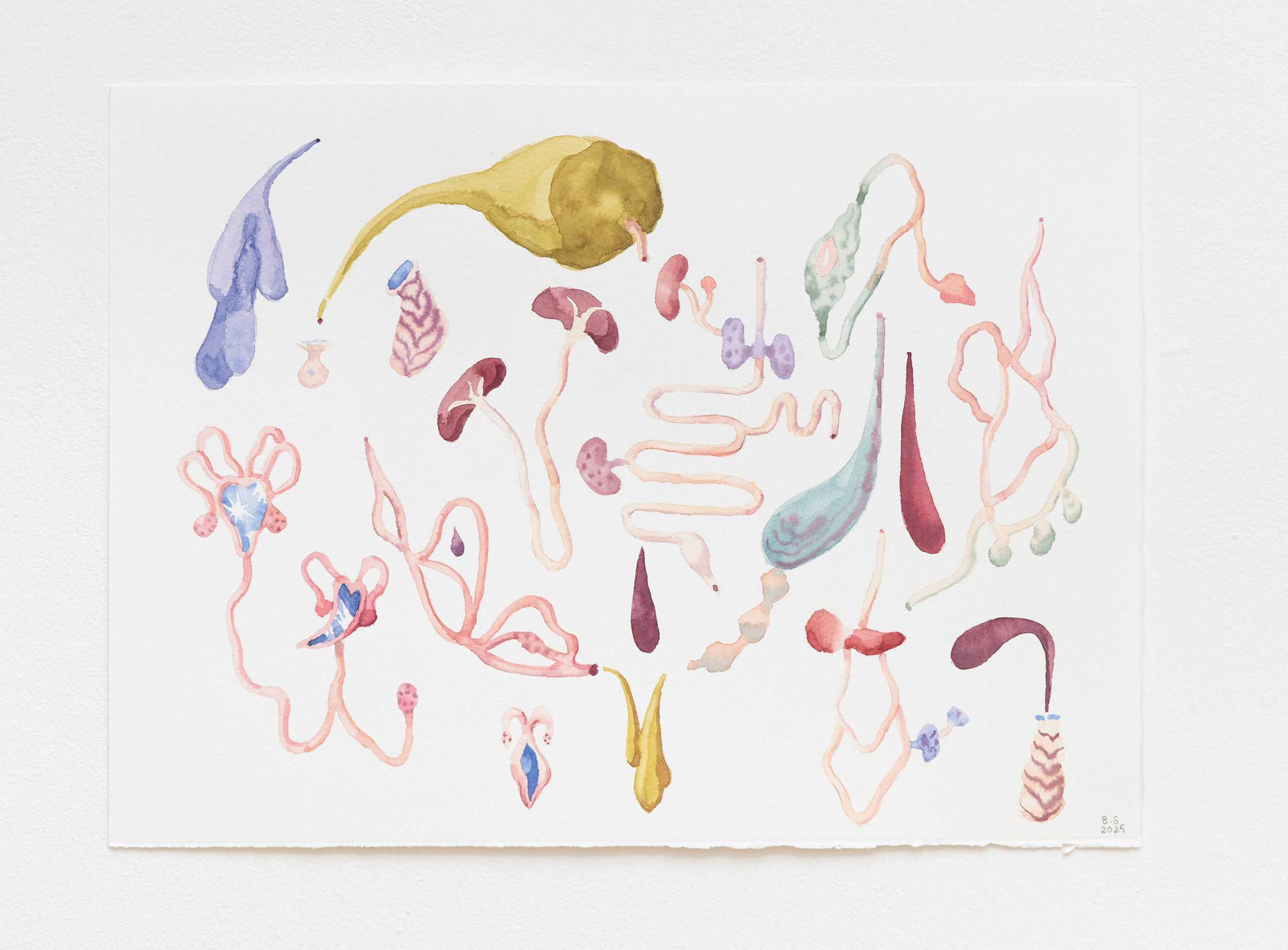
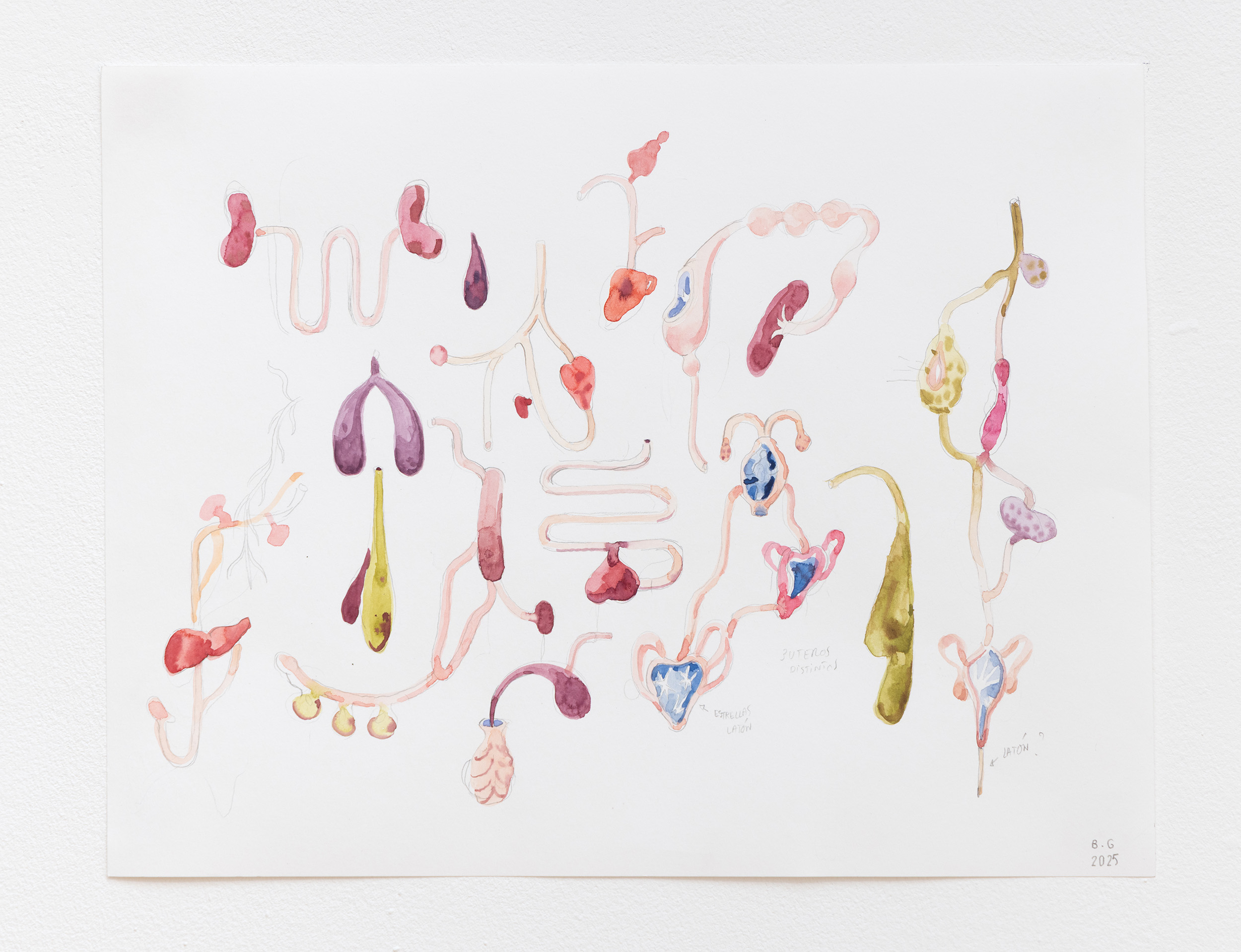
Studies for Internal Landscape
Watercolor on paper
28,5 x 38cm
 Detail of Internal Landscape (2025)
Dyed paper pulp, wire and metal mesh
[ES]
En el centro de la exposición de Blanca Gracia
se encuentra el concepto del horror corporal, la repulsión social hacia un «otro» corporal que no se ajusta a un estándar heteronormativo. Con sus raíces en la mitología griega y sus ramificaciones más recientes entretejidas en todo el géner del terror contemporáneo, Gracia desafía estas ficciones corporales para crear una nueva celebratoria manifestación de un cuerpo en rebelión. Una gigantesca constelación de órganos escultóricos flota, aparentemente sin ataduras, en el espacio de la galería. Su escala evoca la idea de un bosque por el que el visitante puede pasear; un encuentro arbóreo con un «monstruoso» paisaje femenino interno.
La obra de audio que la acompaña fusiona los sonidos
del bosque y del cuerpo, el viento y los latidos del corazón, alineando de nuevo la idea de cuerpo como un potencial desierto, el lugar de los marginados, de las bestias, de los seres míticos. Aprovecha la sensación de vulnerabilidad hacia un mundo menos dominad por las construcciones sociales y provoca al oyente con las conocidas señales de audio del «terror». Hay una invitación de cuento de hadas a explorar, un implícito «si hoy vas al bosque...».
El título de la exposición, Tornapiel, fue
inventado por el artista y deriva de la palabra latina versipellis, qu se traduce literalmente como «piel cambiante». Este término se utilizaba originalmente para definir a criaturas que se parecían a nosotros pero que podían cambiar su apariencia a voluntad, los
precursores romanos de las brujas y los hombres lobo.
En el contexto de la exposición, Gracia literalmente da la vuelta al cuerpo, dando a entender que no son las criaturas en sí mismas las que nos horrorizan,
sino más bien la capacidad humana de manifestar estas formas. La idea de una entidad «desviada» latente en todos nosotros.
Las acuarelas de Gracia, que cubren las paredes de la galería, recuerdan a diagramas médicos arcaicos o libros antiguos sobre anatomía vegetal. Las delicadas líneas, los tonos pastel y los temas descontextualizados
sugieren un orden académico, sin embargo, los cuerpos y las plantas representados por Gracia muestran tendencias anárquicas. Las plantas de hinojo florecen con extrañas figuras que cuelgan del tallo de las plantas y órganos bestiales crecen dentro de un cuerpo humano. En lugar de tener sentido anatómico, plantean preguntas sobre los diagramas didáctico a los que hacen referencia. La obra se basa en la comprensión de cómo la categorización y la semántica se han utilizado históricamente como medios para definir lo«normal» y, al hacerlo, marginar lo «otro». Tornapiel es una celebración de este «otro», una crítica a una sociedad que no reconoce la bestia que hay en su interior.
Paisaje sonoro compuesto por Juan Peralta (Diskoan)
Fotografías de Ben Deakin.
 Campo de’ Fiori, 2025
Watercolour on paper
152 x 57 cm
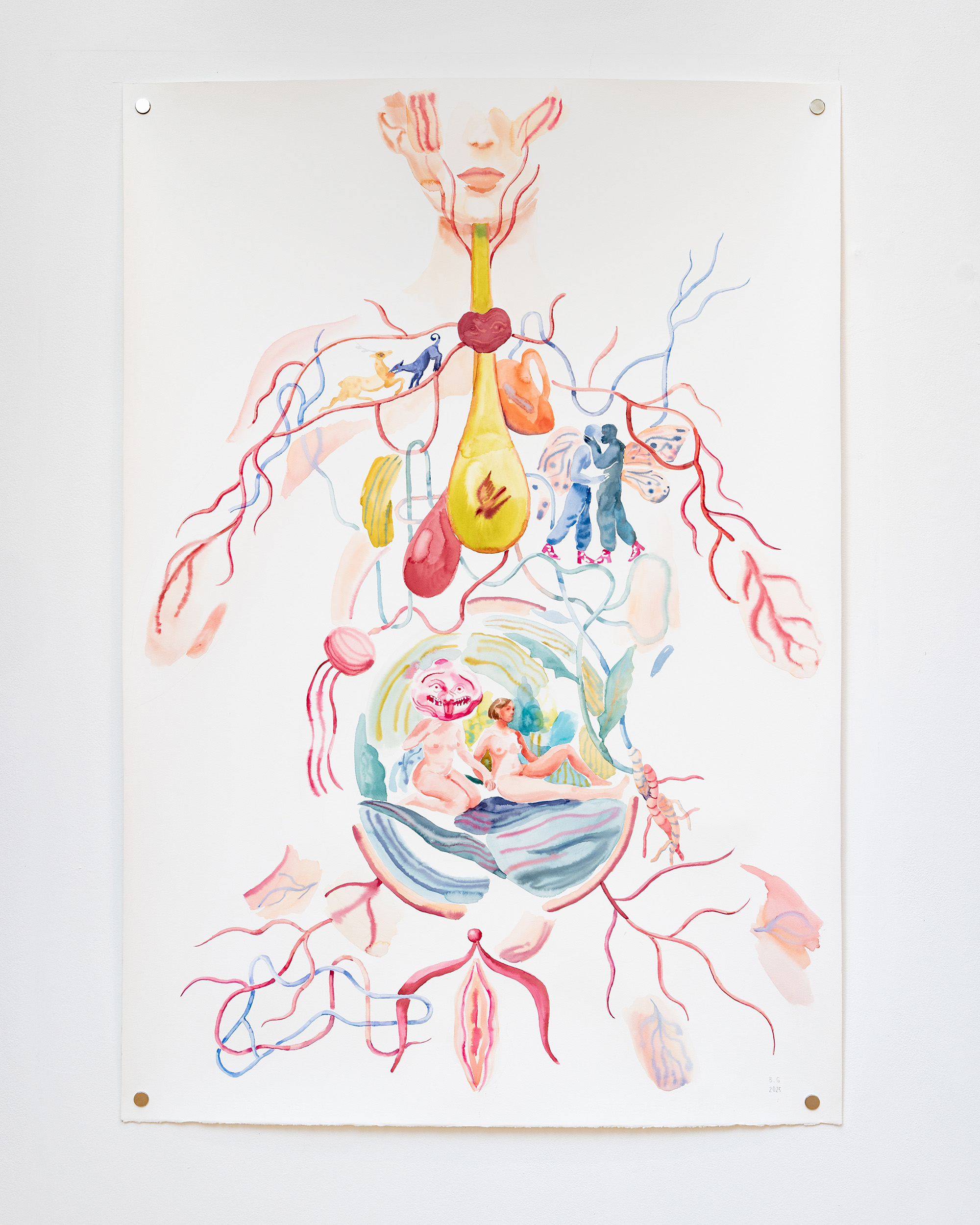 Tornapiel,
2025
Tornapiel,
2025Watercolour on paper
136 x 95 cm